
This post may contain affiliate links. As an Amazon Associate, we earn from qualifying purchases. We only recommend products we trust.
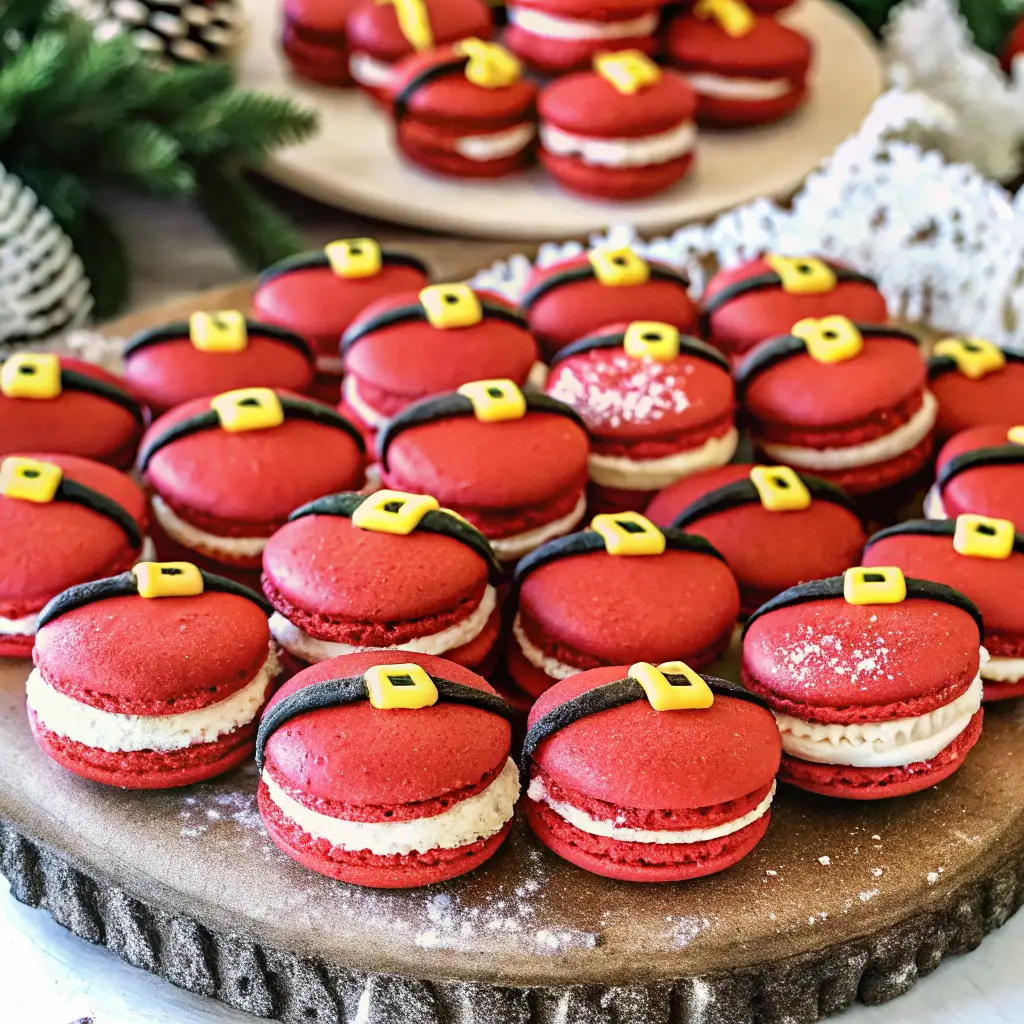
These Santa Claus macarons are adorable Christmas treats that combine perfectly baked red macaron shells with sugar cookie buttercream filling and festive royal icing decorations. With their vibrant red color, black belt detail, gold buckle, and shredded coconut “fur trim,” these holiday macarons look just like Santa’s iconic suit. While macarons require precision and patience, this step-by-step guide walks you through every detail to create stunning Christmas macarons that taste as amazing as they look.
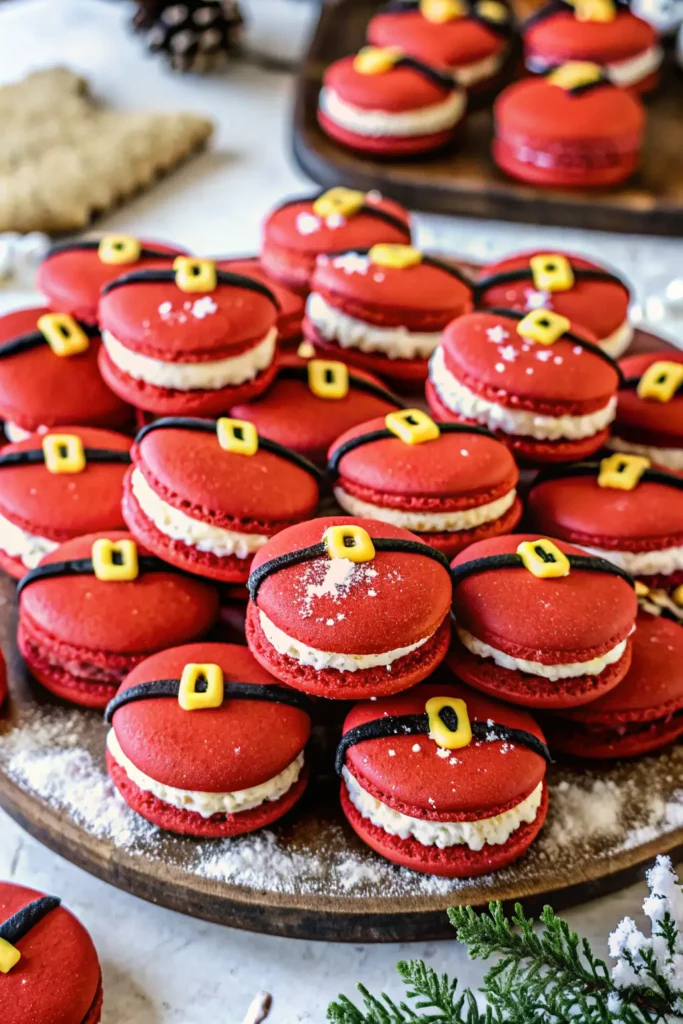
The magic of these festive macarons lies in the thoughtful details—the deep red shells achieved with generous food coloring, the royal icing belt and buckle that add character without complicated decorating, and the rolled coconut edges that give a snowy winter effect. Filled with delicious sugar cookie buttercream that tastes like Christmas morning, these Santa macarons are the ultimate show-stopping holiday dessert for parties, gifts, or cookie exchanges.
Table of Contents
Why These Santa Macarons are Special
These Christmas macarons combine technical baking skills with creative decorating to create truly memorable treats. Unlike simple decorated cookies, macarons require mastering specific techniques—from properly whipping meringue to achieving the perfect macaronage consistency. However, once you understand the fundamentals, these Santa Claus macarons are surprisingly achievable and incredibly rewarding to make.
The royal icing decoration technique is genius in its simplicity. Rather than complicated piping or painting, you simply pipe straight lines for the belt and a small square for the buckle. The royal icing dries quickly and adds dimensional detail that makes each macaron look professionally crafted. This method is far easier than attempting to create the design with macaron batter itself.
Rolling the edges in shredded coconut adds that special finishing touch that transforms these from red macarons into unmistakable Santa treats. The white coconut resembles snow or fur trim, completing the Santa suit illusion while adding subtle texture and flavor. It’s a small detail that makes a big visual impact.
Ingredients for Santa Claus Macarons
Macaron Shells:
- 100 grams golden sugar (or granulated sugar)
- 100 grams egg whites, room temperature
- 4 grams egg white powder (optional but recommended)
- 105 grams almond flour
- 105 grams powdered sugar
- 1 tablespoon red gel food coloring
Royal Icing:
- 1 1/2 cups powdered sugar (187 grams)
- 1 tablespoon meringue powder
- 4 tablespoons water
- 2 drops black gel food coloring
- 1 drop yellow gel food coloring
Sugar Cookie Buttercream:
- 1/2 cup all-purpose flour (63 grams)
- 1/2 cup unsalted butter, softened (113 grams)
- 1/4 cup golden sugar (50 grams, or brown/granulated)
- 1 1/4 cups powdered sugar (156 grams)
- 1 teaspoon vanilla extract
- 1/8 teaspoon almond extract
- 1/2 tablespoon milk or heavy cream
Decoration:
- 1/4 cup shredded coconut (50 grams)
Understanding Key Ingredients
Egg White Powder: This optional ingredient strengthens the meringue structure, helping create more stable shells with better feet development. While not essential, it provides insurance against common macaron problems like hollow shells or cracking. If you skip it, nothing else in the recipe changes.
Almond Flour: Use finely ground, blanched almond flour for smooth, professional-looking shells. Coarsely ground almond meal creates bumpy, rustic shells. Always sift the almond flour with powdered sugar to remove any large pieces that could cause imperfections.
Red Gel Food Coloring: Achieving vibrant red requires generous food coloring—expect to use about 1 tablespoon of gel coloring. Don’t be shy with the amount; macaron colors fade slightly during baking. The trade-off is extended drying time before baking (up to 2 hours) to accommodate the extra moisture from the coloring.
Golden Sugar: This specialty sugar sits between brown sugar and white sugar in molasses content, offering a subtle nutty, caramel flavor. Substitute with half brown and half white sugar if you can’t find golden sugar.
Meringue Powder: This dried egg white and stabilizer mixture makes quick, safe royal icing without raw eggs. It’s shelf-stable and creates perfectly pipeable icing that dries hard and glossy.
Heat-Treated Flour: The buttercream uses heat-treated flour to make it safe for consumption without baking. This simple 5-minute oven treatment kills potential bacteria while maintaining the flour’s thickening properties.
How to Make Santa Claus Macarons
Step 1: Prepare Your Workspace
Line two baking sheets with parchment paper or silicone baking mats. Using macaron templates helps create uniform circles—slide the template under parchment paper for guidance. Prepare a large piping bag fitted with a 1/4-inch round tip. Sift together the almond flour and powdered sugar, then set aside.
Preheat your oven well in advance—at least 60-90 minutes for conventional ovens. Use 300°F for standard ovens or 270°F for convection ovens. This extended preheat stabilizes the temperature and prevents fluctuations that can ruin macarons.
Step 2: Make Italian Meringue
Place the golden sugar and egg white powder (if using) in a heatproof bowl set over a pan of barely simmering water. Whisk to prevent clumping. Add the egg whites and whisk constantly until the sugar completely dissolves—test by rubbing a bit between your fingers. If you feel no grittiness, it’s ready. This takes 2-3 minutes.
Transfer the warm egg white mixture to your stand mixer bowl. Start whipping on low speed for 30 seconds, then increase to medium for 2 minutes. Finally, increase to medium-high and whip until stiff peaks form—typically 13-15 minutes total. The meringue should be glossy, form stiff peaks that stand straight up, and show defined streaks from the whisk. Don’t over-whip, as this causes hollow macarons.
Step 3: Make Macaronage (Mix the Batter)
Pour the sifted almond flour and powdered sugar mixture over the meringue. Add the red gel food coloring now—about 1 tablespoon for vibrant color. Begin folding gently using a J-motion with your spatula, scraping around the sides and bottom of the bowl.
Once the dry ingredients incorporate, start pressing the batter against the sides of the bowl to deflate it slightly while folding. This macaronage process is crucial. Continue until the batter flows thick and glossy off the spatula in a continuous ribbon. Test by drawing figure-8s with the falling batter—if you can complete several without the batter breaking, you’re close. The batter falling back into the bowl should reincorporate within 10-15 seconds.
Step 4: Pipe the Shells
Transfer the batter to your prepared piping bag. Hold the bag perpendicular (90 degrees) to the baking sheet, directly over the center of each circle template. Apply steady pressure for 3-5 seconds, then quickly pull straight up with a slight twist. This motion prevents peaks.
After piping all circles, firmly bang the baking sheets against the counter several times to release air bubbles. Use a toothpick to pop any remaining bubbles on the surface.
Step 5: Rest the Shells
This step is critical when using heavy food coloring. Let the piped shells rest until they form a dry skin—you should be able to lightly touch the surface without batter sticking to your finger. This can take 30 minutes to 2 hours depending on humidity and food coloring amount. The shells must be completely dry before baking to prevent cracking. Be patient; proper drying ensures smooth, crack-free shells.
Step 6: Bake the Macarons
Bake one tray at a time for 15-20 minutes, though timing varies significantly by oven. The shells should develop feet, deepen in color slightly, and feel firm when gently touched—not jiggly. If they still feel soft or jiggly, continue baking.
Allow shells to cool completely on the baking sheet before removing. They should lift off easily when fully cooled.
Step 7: Make Royal Icing
Combine powdered sugar and meringue powder in a mixer bowl. Mix on low while gradually adding water. Increase speed to medium-high and whip for several minutes until glossy and fluffy. The consistency should resemble sweetened condensed milk—flowable but not runny. Adjust with water (to thin) or powdered sugar (to thicken) as needed.
Divide the icing between two bowls. Color one black and one yellow using gel food coloring. Transfer black icing to a piping bag with a size 3 tip, and yellow icing to a bag with a size 2 tip. Keep covered when not using to prevent drying.
Step 8: Decorate with Royal Icing
Select half your shells for decoration (the other half will be bottoms). Pipe a straight horizontal line of black royal icing across the center of each shell to create Santa’s belt. Let dry for 5-10 minutes—refrigerating speeds this process.
Once the black belt is dry, pipe a small square of yellow icing in the center to create the buckle. The yellow shows up beautifully against the black belt. Let the icing dry completely before filling.
Step 9: Make Sugar Cookie Buttercream
Heat-treat the flour first: spread it on a parchment-lined baking sheet and bake at 350°F for 5 minutes, stirring halfway through. It should feel hot to the touch. Cool completely.
Beat butter and sugars for 4-5 minutes until light and fluffy. Add the cooled flour, vanilla extract, and almond extract. Mix on low until combined. Add milk or cream if needed for spreadable consistency. The buttercream should taste like sugar cookie dough.
Step 10: Assemble the Macarons
Transfer buttercream to a piping bag fitted with a round tip. Pipe a generous amount onto the bottom (undecorated) shells. Top each with a decorated shell, gently pressing to spread the filling to the edges.
Roll the sides of each assembled macaron in shredded coconut, pressing gently so it adheres. The coconut creates that snowy Santa trim effect that completes the look.
Pro Tips for Perfect Santa Macarons
Achieving Vibrant Red: Don’t be afraid to use lots of food coloring—1 tablespoon isn’t excessive for bright red. The color fades slightly during baking, so it should look almost too red in the batter.
Extended Drying Time: Heavy food coloring adds moisture. Plan for 1-2 hours of drying time, especially in humid climates. A dehumidifier helps significantly.
Test Your Oven Temperature: Use an oven thermometer to verify actual temperature. Many ovens run 25°F off, which dramatically affects macaron success.
Don’t Rush Macaronage: Under-mixed batter creates thick shells without feet; over-mixed batter creates flat, spread-out macarons. Practice recognizing the perfect ribbon-like consistency.
Royal Icing Consistency: Too thick won’t pipe smoothly; too thin won’t hold shape. Test on parchment paper first and adjust before piping on macarons.
Buttercream Temperature: If buttercream is too soft, refrigerate briefly. Too stiff? Let it sit at room temperature or add a tiny bit more milk.
Creative Variations
Mrs. Claus Macarons: Use pink shells instead of red, and add a small rosette of white royal icing for hair instead of the belt buckle.
Simplified Version: Skip the royal icing decoration and simply roll the entire macaron edge in coconut for a snowy effect.
Different Fillings: Try peppermint buttercream, chocolate ganache, or cream cheese frosting instead of sugar cookie buttercream.
Mini Santa Macarons: Use a smaller piping tip to create mini versions—perfect for dessert platters or gifts.
Vegan Adaptation: Use aquafaba (chickpea liquid) in place of egg whites. Results vary but can be successful with practice.
Storage and Make-Ahead Instructions
Refrigerator: Store assembled macarons in an airtight container in the refrigerator for up to 5 days. The buttercream keeps them fresh and actually improves texture over time as flavors meld.
Freezer: These macarons freeze beautifully for 1-2 months. Place in a single layer in airtight containers with parchment between layers. Thaw in the refrigerator for several hours or overnight before serving.
Aging Process: Macarons actually taste better after 24 hours in the refrigerator. The filling softens the shells slightly, creating that perfect chewy texture macarons are famous for.
Component Make-Ahead: Bake and decorate shells up to 3 days ahead. Store unfilled at room temperature in airtight containers. Make buttercream 2 days ahead and refrigerate. Assemble on the day of serving or the day before.
Frequently Asked Questions
Why are my macarons cracking? Usually due to insufficient drying time before baking. With heavy food coloring, shells need extra time to form a dry skin. Oven temperature too high can also cause cracking.
Why don’t my macarons have feet? Under-mixed batter, under-whipped meringue, or insufficient oven temperature are common causes. Ensure proper macaronage and verify oven temperature with a thermometer.
Can I make macarons without egg white powder? Yes! It’s optional. The macarons will still work but may be slightly more delicate. Nothing else needs changing in the recipe.
How do I know when macaronage is done? The batter should flow continuously off the spatula in a thick ribbon, and batter falling back into the bowl should reincorporate within 10-15 seconds. Practice makes perfect!
Can I use regular white sugar instead of golden sugar? Yes, absolutely. Golden sugar adds subtle caramel notes but regular granulated sugar works perfectly.
Why is my royal icing not hardening? Too much water in the mixture. Add more powdered sugar to thicken. Proper royal icing should dry hard within 30 minutes.
Can I make the buttercream without heat-treating flour? Not recommended for food safety. Raw flour can contain harmful bacteria. The heat treatment takes only 5 minutes and makes it completely safe.
These Santa Claus macarons are the ultimate festive treat that combines technical skill with creative flair. While they require patience and attention to detail, the stunning results are absolutely worth the effort. Make a batch for your next holiday celebration and watch them disappear faster than Santa on Christmas Eve!
Santa Claus Macarons
Equipment
- Stand mixer with whisk attachment
- Mixing bowls
- Kitchen scale
- Spatula
- Piping bags and round tips
- Baking Sheets
- Silicone baking mats or parchment
- Oven thermometer
- Toothpicks (for air bubbles)
Ingredients
- Macaron Shells
- 100 g golden sugar (or granulated sugar)
- 100 g egg whites, room temperature
- 4 g egg white powder (optional)
- 105 g almond flour, finely ground and sifted
- 105 g powdered sugar
- 1 tbsp red gel food coloring
- Royal Icing
- 1 1/2 cups powdered sugar (187 g)
- 1 tbsp meringue powder
- 4 tbsp water
- 2 drops black gel food coloring
- 1 drop yellow gel food coloring
- Sugar Cookie Buttercream
- 1/2 cup all-purpose flour (heat-treated)
- 1/2 cup unsalted butter, softened
- 1/4 cup golden sugar (or brown/granulated)
- 1 1/4 cups powdered sugar
- 1 tsp vanilla extract
- 1/8 tsp almond extract
- 1/2 tbsp milk or heavy cream, as needed
- Decoration
- 1/4 cup shredded coconut (for rolling edges)
Instructions
- Line two baking sheets with parchment or silicone mats. Sift almond flour and powdered sugar together. Prepare piping bag with round tip and preheat oven to 300°F (270°F convection).
- Whisk egg whites, sugar, and egg white powder over simmering water until sugar dissolves. Transfer to mixer bowl and whip to stiff, glossy peaks, about 13–15 minutes.
- Fold sifted almond flour mixture into meringue with red gel food coloring. Mix until batter flows in thick ribbons and settles within 10–15 seconds.
- Pipe circles onto prepared sheets. Tap trays to release air bubbles and rest 30–120 minutes until shells form a dry skin.
- Bake one tray at a time for 15–20 minutes, until feet form and shells feel firm. Cool completely before removing.
- Beat powdered sugar, meringue powder, and water until glossy and smooth. Divide and color black and yellow. Pipe black belts and yellow buckles on half of the cooled shells.
- Heat-treat flour at 350°F for 5 minutes and cool. Beat butter and sugars until light, add cooled flour, vanilla, almond extract, and milk until creamy.
- Pipe buttercream on undecorated shells, top with decorated ones, and roll edges in shredded coconut for Santa’s trim.
- Refrigerate assembled macarons 24 hours for best texture. Serve chilled or at room temperature.